The debate over freedom of speech has become one of the defining issues of our time. Across Australia, people are increasingly asking whether free speech in Australia is being eroded by regulation, cultural pressure and corporate control. In Victoria, new anti-vilification laws pose a threat to freedom of speech.
The Libertarian Party of Victoria believes this concern is well founded. The principles of freedom of speech, freedom of expression and open debate are under pressure from multiple directions. If these freedoms are weakened, the consequences extend far beyond politics. They affect truth, accountability, innovation and the ability of individuals to live freely.

Why Free Speech Matters
At its core, freedom of speech is about more than the right to speak. It is about the right to question authority, challenge ideas and search for truth. The philosopher John Stuart Mill argued that even unpopular or offensive opinions must be heard, because suppressing ideas prevents society from testing and refining them.
This concept underpins modern human rights frameworks and is recognised in international law, including the International Covenant on Civil and Political Rights, which protects freedom of expression.
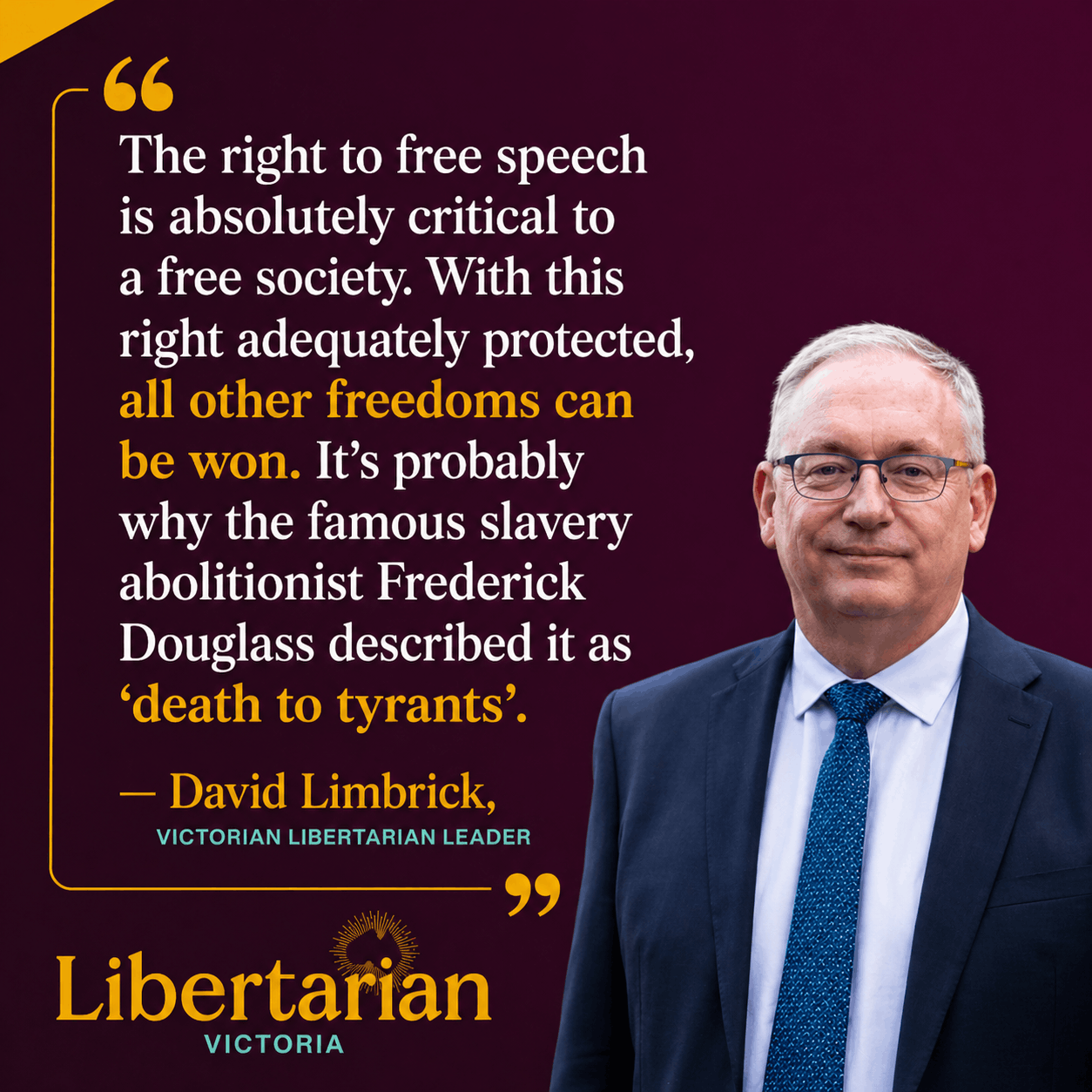
The Libertarian view is simple. A society that restricts speech cannot remain free. As Victorian Libertarian leader David Limbrick explains:
"The right to free speech is absolutely critical to a free society. With this right adequately protected, all other freedoms can be won. It’s probably why the famous slavery abolitionist Frederick Douglass described it as ‘death to tyrants’."
Free Speech Australia: Limited Legal Protection
Despite its importance, free speech in Australia, including the state of Victoria, lacks strong legal protection. Unlike the United States, which has the First Amendment, Australia has no explicit constitutional right to free speech.
Instead, the Australian Constitution contains a limited doctrine known as the Implied Freedom of Political Communication, developed by the High Court of Australia. This protection is narrow. It applies only to political speech and does not guarantee a general right to express opinions freely.
This means that under Australian law, speech can be restricted more easily than many people assume. Courts such as the High Court and the Supreme Court interpret these limits, but without clear constitutional protection, their role is constrained.
Expanding Restrictions on Speech
In recent years, restrictions on free speech have grown in several areas.
Defamation Law and Chilling Effects on Freedom of Speech
Australia’s strict defamation law creates significant chilling effects. Journalists, commentators and individuals often avoid speaking out due to fear of legal action. This undermines media freedom and weakens public accountability.
Anti-Vilification Laws and Hate Speech
Anti-vilification laws and regulations targeting hate speech are often broad in scope. While intended to prevent harm, they can restrict legitimate debate and discourage open discussion on controversial topics.
Classification and Censorship
Australia’s system of classification and censorship regulates content across film, literature and digital media. These rules can limit access to information and restrict expression in ways that are inconsistent with a free society.
Government Regulation and Oversight
Bodies such as the Australian Human Rights Commission and proposals supported by the Australian Law Reform Commission have expanded regulatory frameworks affecting speech. While framed as protecting the public interest, these measures often increase control over what people can say.
New Victorian Anti-Vilification Laws and the Libertarian Response
Victoria’s new anti-vilification laws represent one of the most significant expansions of speech regulation in recent years. Introduced through the Justice Legislation Amendment (Anti-vilification and Social Cohesion) reforms, the laws broaden protections beyond race and religion to include attributes such as gender identity, disability and sexual orientation. They also introduce new criminal offences, including inciting hatred or making threats based on a protected attribute, with penalties of up to five years’ imprisonment.
Supporters argue these changes are necessary to protect vulnerable groups and strengthen social cohesion. The Victorian Government has framed the reforms as ensuring all Victorians can live free from hate and discrimination. However, from a Libertarian perspective, the problem lies not in the intention but in the scope and structure of the laws.
The Libertarian Party of Victoria, under the leadership of David Limbrick, opposed these reforms because they significantly expanded the boundaries of what can be considered unlawful speech. The legal threshold for vilification includes conduct that may “incite hatred, serious contempt, revulsion or severe ridicule”. While these terms may appear reasonable, they are inherently subjective. What one person considers criticism or robust debate; another may interpret as vilification.
This ambiguity creates real risk. As critics have noted, the broadened definitions could expose individuals to legal action for expressing controversial or unpopular views. In practice, this leads to chilling effects, where individuals self-censor to avoid legal consequences. Over time, this reduces the diversity of opinions in public discourse and weakens the marketplace of ideas.
From a Libertarian viewpoint, the danger is not just legal enforcement, but the cultural shift these laws encourage. When the state defines the boundaries of acceptable speech, it shapes what can be discussed openly. This is particularly concerning in areas such as religion, politics and social policy, where strong disagreement is both normal and necessary.
The laws also extend to speech in private settings and online environments, meaning that conversations once considered part of everyday life may now fall under legal scrutiny. Combined with existing content moderation practices on internet platforms, this creates a layered system of control where both government and corporations influence speech.
The Libertarian Party’s opposition is grounded in a simple principle: the best response to offensive or harmful speech is more speech, not enforced silence. Existing criminal laws already address direct harm, such as threats or incitement to violence. Expanding anti-vilification laws risks going beyond preventing harm and into regulating opinion.
This is why Libertarians argue that these laws ultimately undermine Freedom of expression. A free society must tolerate disagreement, even when it is uncomfortable. Without that tolerance, the space for open debate shrinks, and with it, the ability to challenge authority and pursue truth.
The Digital Age: New Challenges for Free Speech
The rise of the digital age has transformed how people communicate. Social media, internet platforms and other forms of digital communication now act as the primary public forum for debate.
However, this shift has created new challenges.
Content Moderation and Corporate Control
Platforms engage in content moderation to comply with laws and avoid penalties. This often leads to the removal of lawful speech. Decisions about what content is acceptable are made by private companies rather than through open democratic processes.
Government Pressure on Platforms
Governments increasingly pressure platforms to remove content labelled as misinformation or disinformation. As noted in Libertarian policy materials, these terms are often used to suppress views that challenge official narratives.
This dynamic creates a system where both government and corporations influence what information is available.
The Risk to Public Discourse
When speech is restricted online, it damages public discourse. Open debate is essential for testing ideas and identifying the truth. Suppressing speech reduces the diversity of viewpoints and limits the ability of individuals to engage meaningfully.
Media Freedom and Decentralisation
A free society depends on media freedom and a diversity of information sources. Concentrated control, whether by government or large corporations, limits the range of perspectives available.
The Libertarian vision emphasises decentralisation. By reducing barriers to entry and encouraging competition, a wider range of voices can emerge. This strengthens the marketplace of ideas and improves the quality of public debate.
The policy also highlights the need to remove government involvement in the media, which can distort the flow of information.
The Libertarian Approach to Free Speech
The Libertarian Party proposes a comprehensive framework to restore freedom of speech in Australia.
Enshrine Freedom of Speech in the Constitution
The party supports a referendum to strengthen the Australian Constitution, providing clear protection for Freedom of expression similar to the First Amendment.
Abolish Section 18C
Section 18C of the Racial Discrimination Act restricts speech that offends or insults. Libertarians argue that this goes beyond protecting individuals from harm and limits legitimate discussion.
Oppose Misinformation Laws
As outlined in policy, laws targeting misinformation and disinformation should be repealed. These laws give regulators excessive power over speech.
Reform Defamation Law
Reforms are needed to reduce the chilling effect of defamation laws while maintaining protections against genuine harm.
Reduce Classification and Censorship
Simplifying or removing unnecessary classification rules would allow greater access to information and support creative expression.
Protect Online Speech
Government should not compel platforms to censor lawful content. Internet platforms should remain open spaces for debate.
Free Speech and Human Rights
The Libertarian position aligns strongly with international human rights principles. The United Nations recognises freedom of expression as a fundamental right under the International Covenant on Civil and Political Rights.
However, Libertarians argue that these rights must be actively protected, not just recognised in theory. Expanding regulation risks undermining these protections.
The Role of the Courts and Freedom of Speech
Courts play an important role in interpreting speech laws. The High Court of Australia has recognised the importance of political communication, but its decisions provide limited protection.
Without stronger constitutional safeguards, courts cannot fully defend free speech. This highlights the need for legislative and constitutional reform.
Free Speech and the Public Interest
Some argue that restricting speech is necessary to protect the public interest. Libertarians challenge this view.
The public interest is best served by open debate. When individuals can freely exchange ideas, society benefits from a wider range of perspectives and better decision-making.
Restricting speech assumes that authorities are better placed to determine truth. History shows this is often not the case.
Addressing Harm Without Censorship
Where speech involves threats or incitement to harm this should be addressed through criminal law. Laws in this area are well developed and require enforcement.
Broad censorship does not stop harm. Instead, it suppresses open debate that exposes and challenges harmful ideas.
This approach preserves freedom while maintaining social order.
The Future of Free Speech in Australia
The future of free speech in Victoria and Australia in general depends on the choices made today. Expanding regulation may seem like a solution to immediate problems, but it carries long-term risks.
The Libertarian Party of Victoria argues for a different path. One that trusts individuals, encourages debate and limits government intervention.
In a world where information flows rapidly and widely, protecting freedom of speech and freedom of expression is more important than ever.
Your Voice, Your Freedom
The fight for free speech in Australia is ultimately about who controls ideas. Is it governments, regulators and corporations, or is it individuals?
The Libertarian Party of Victoria believes that power should rest with the people. By strengthening Freedom of speech, reducing regulation and promoting open dialogue, Australia can remain a free and vibrant society.
As David Limbrick reminds us, free speech is the foundation of all other freedoms. Without it, everything else is at risk.
Your voice matters. Your freedom matters. And defending free speech in Australia is essential to protecting both.